
Blog
Why Payout Speed Data Belongs in a Casino Trust Score (and Why Most Ratings Skip It)

A single aggregate score cannot tell you whether a casino pays out quickly, because averaging hides exactly the inputs a reader most needs isolated. Withdrawal speed depends on verification timing, payment rail mechanics, and manual review flags. Published ratings rarely break it out on its own, so you need a method for weighing it yourself before trusting any trust score. The signal is in the terms, the complaint records, and the timing of verification checks. Speed is one input among many, not a verdict on the whole operation.
Why One Star Rating Can’t Tell You If You’ll Wait
Any single number that claims to summarize a casino’s trustworthiness is a compression algorithm. It takes dozens of distinct inputs, including payout speed, customer support quality, game fairness, user experience, licensing status, and complaint history. It squeezes them into one digestible figure. That process necessarily discards information.
Aggregation helps you compare options quickly and spot obvious outliers. The compression discards details that can matter more than the average. When a rating system averages ten inputs into one score, a casino that is excellent on nine of them but slow on payouts can still land near the top. The reader who chose based on that score never saw the one input that would matter most at the moment of withdrawal.
Payout speed is uniquely vulnerable to this kind of averaging. It is a process outcome that depends on your specific situation, including your verification status, your chosen payment method, and the operator’s internal review queue. A rating that captures “average withdrawal time” across all players and all methods tells you very little about what you will experience. A star rating cannot show you that the casino holds withdrawals until document checks are complete, even when those checks take longer than the published processing window. It cannot show you that e-wallet payouts clear quickly while bank transfers sit in a manual review queue. It cannot show you that a support agent’s promise of “24 hours” is not a contractual commitment.
The rating also cannot show you the difference between a casino that is slow because its payment rails are genuinely inefficient and one that is slow because it flags a high percentage of withdrawals for manual review. Both produce the same outcome: you wait. They imply different things about the operator’s intent and competence.
A trust score is a summary of averages, and averages are exactly the wrong tool for predicting a single withdrawal event. Your withdrawal is a specific transaction with a specific verification history and a specific payment method. It is not an average.
Ratings are worth keeping if they publish their component inputs, or if you read the underlying methodology before acting on the score. If a rating system does not tell you how it weighs payout speed, or does not measure it at all, then the score is telling you less than it looks like it does.
What Actually Drives Withdrawal Speed
Three distinct factors determine how long a withdrawal takes. They are often conflated in casual discussion, but they operate on different timelines and have different root causes.
KYC and Identity Verification Holds
The single largest source of withdrawal delay is the know-your-customer (KYC) process that precedes the payout. Licensed operators are required to verify your identity before releasing funds, and many choose to run that verification at the moment of withdrawal.
You sign up, deposit, and play without issue. You request a withdrawal, and suddenly the casino asks for proof of identity, such as a passport scan, a utility bill, or a photo of your payment card. The clock on your withdrawal does not start until those documents are submitted and checked. If you submitted them at registration, the process is faster. If you wait until withdrawal, you add days to the timeline.
The verification hold is a compliance requirement that exists to prevent fraud, money laundering, and underage gambling. The timing of the check matters enormously. An operator that verifies at registration is signaling that it wants withdrawals to be smooth. An operator that verifies at withdrawal is signaling that it prioritizes compliance efficiency over payout speed, and you will bear the cost of that priority.
Document review is manual in many cases. A human being must look at your passport and compare it to your account details. That human being works business hours, takes breaks, and has a queue. If your documents are submitted on a Friday afternoon, the review may not begin until Monday. None of this is visible in a star rating.

Payment Rail Mechanics
Once verification is complete, the payment method itself becomes the constraint. Different rails move money at different speeds because they involve different numbers of intermediaries.
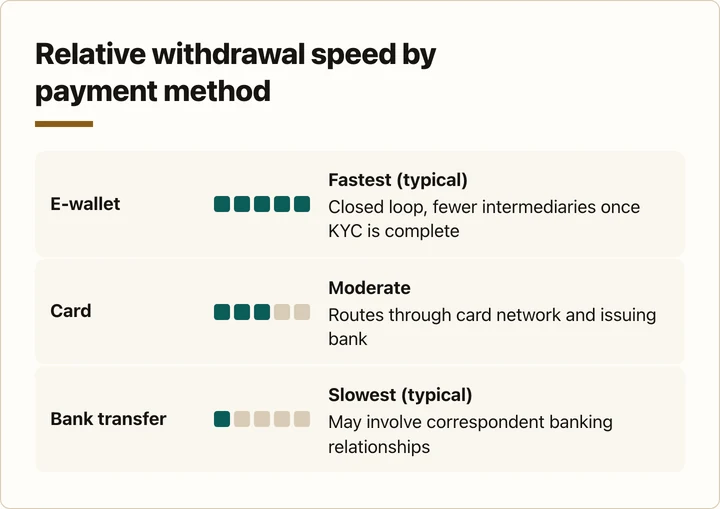
E-wallets typically process faster than card or bank transfers, because the casino’s responsibility ends the moment funds land in your wallet balance and the verification chain has fewer intermediaries once KYC is complete. The comparison section below breaks down why each payment rail moves at a different speed.
Cards and bank transfers involve more parties. A card withdrawal may route through the card network, the issuing bank, and the acquiring bank before funds appear in your account. A bank transfer may involve correspondent banks if the casino’s banking partner is different from yours. Each intermediary adds processing time and a potential point of failure. The qualitative difference is consistent. E-wallets are faster than cards, and cards are generally faster than direct bank transfers. This is a statement about mechanics. A casino can process an e-wallet withdrawal instantly and still be slow overall if it holds every withdrawal for manual review before releasing it to the wallet.
Manual Review Flags
Some withdrawals trigger additional scrutiny. Large amounts, first-time withdrawals, withdrawals following bonus play, or withdrawals to a payment method different from the deposit method can all flag a transaction for manual review.
Manual review is a human process. A compliance officer looks at the transaction, checks it against your play history and deposit records, and decides whether to release it. This is a fraud-prevention measure. It adds unpredictable time to the withdrawal, and the criteria for triggering review are rarely published in full.
Manual review flags reveal a casino’s true payout speed philosophy. An operator that automates most withdrawals and reviews only a small percentage will be fast on average. An operator that manually reviews a high percentage of withdrawals will be slow on average, even if its payment rails are identical. You cannot see this distinction in a star rating. You can only see it in the operator’s published terms, in the experience reports of other players, and in the complaint records published by regulators.
E-Wallets vs Cards vs Bank Transfer, in Plain Terms
The payment method you choose at withdrawal is one of the few variables you fully control. Understanding the qualitative differences helps you set realistic expectations.
E-wallets sit at the fast end of the spectrum. The casino transfers funds to your wallet balance, and that transfer is typically the end of the casino’s involvement. You then control the timing of the onward transfer to your bank. The tradeoff is that you must have funded your account via the e-wallet in the first place. Most operators will not pay out to a method you never used to deposit.
Cards occupy the middle ground. The withdrawal routes back to the card you used for deposits, which means the verification chain includes the card network and your issuing bank. Processing is generally faster than a direct bank transfer but slower than an e-wallet, because the card network adds a step.
Bank transfers are the slowest of the three in most cases. Direct bank transfers may involve correspondent banking relationships, which add intermediaries and processing days. The tradeoff is that bank transfers are often the only option for very large withdrawals, and they carry no intermediary balance that could be subject to holds.
If payout speed matters to you, choose an e-wallet for deposits and withdrawals, and complete KYC verification at registration. This combination removes the two largest sources of delay, verification holds and intermediary routing. Only the casino’s own processing time remains.
Where Regulators Fit In
Regulators do not set payout speed standards in the sense of mandating a specific number of hours. They do require licensed operators to handle complaints and disputes through defined processes, and they publish guidance that players can use when a withdrawal goes wrong. The UK Gambling Commission requires its licensees to handle player complaints and disputes in a defined, documented process, and players who exhaust an operator’s internal complaints process can escalate through an approved dispute-resolution route. The existence of this process does not guarantee a fast payout, but it does guarantee a documented path for recourse. See our licensing and compliance guide for how this fits into a wider trust picture.
The Malta Gaming Authority similarly publishes consumer-facing guidance and maintains a complaints channel for players of licensed operators. The MGA’s consumer pages explain what to do when you have a dispute, how to contact the Authority, and what information you need to provide.

When you read a trust score, check whether the rating accounts for the operator’s licensing status and complaint history. A casino that is licensed by a reputable regulator and has a clean complaint record is operating within a framework that gives you recourse if something goes wrong. A casino that is unlicensed or licensed in a weak jurisdiction may be fast or slow, but your options if a withdrawal is stuck are far more limited.
Regulators are arbiters of process. Their value to you is that they make casinos accountable when payouts fail. That accountability is a meaningful component of trust, even though it is distinct from speed itself.
A Simple Method: Read the Terms Before You Read the Score
You do not need to be a ratings analyst to evaluate payout speed. You need a checklist and the willingness to read the operator’s published terms before you commit money.
Check the withdrawal policy first. The operator’s terms should state its processing times for each payment method. Look for language that distinguishes between “processing time” (the casino’s internal review) and “transfer time” (the payment rail’s delivery). Many disputes arise because players confuse the two.
Look for verification requirements. Does the operator require document submission at registration or at withdrawal? If the terms say verification is required before the first withdrawal, assume that your first payout will include a verification hold. Plan for it.
Check the payment methods. Does the operator support e-wallets for both deposit and withdrawal? If you deposit by card but want to withdraw by bank transfer, you may face a slower rail and an additional verification step.
Search for complaint patterns. Regulator complaint pages and player forums reveal patterns that terms pages do not. If a recurring theme is “withdrawal pending for weeks after verification,” that is a signal that the operator’s manual review queue is a bottleneck.
Time your request. Request withdrawals early in the week, not on Friday afternoon. Verification teams and payment departments operate on business hours. A Friday request can add two days of calendar time before anyone looks at it.
Keep documentation. Save your verification documents, your withdrawal request confirmation, and any support chat transcripts. If a dispute escalates to a regulator, you will need to document the timeline.
This method does not require you to trust any published score. It requires you to verify the inputs yourself. The score can tell you where to look. The terms tell you what to expect.
Where This Fits in a Broader Trust Score
Payout speed is one input among many in a comprehensive trust assessment. It is an important input, but it should not be treated as a proxy for overall trustworthiness.
A casino can pay out quickly and still be untrustworthy in other ways. It can offer fast withdrawals while using unfair game rules, providing poor customer support, or failing to honor bonus terms. Speed is a necessary condition for a positive experience, but it is not a sufficient condition for trust. A casino can also be slow to pay out while being otherwise reliable. Slow processing is frustrating, but it is not the same as non-payment. A casino that eventually pays every withdrawal, even slowly, is different from one that invents reasons to avoid payment altogether.
The right mental model is a dashboard. You want to know the operator’s speed, its support quality, its game fairness, its licensing status, and its complaint history as separate data points. A trust score that compresses all of these into one number is useful only if you can also see the components.
Editorial methodology matters here. A ratings system that publishes its component scores and explains its weighting is more useful than one that presents a single opaque number. When you read a trust score, ask what methodology produced it. Our own editorial policy lays out how we weigh each input. If the methodology does not mention payout speed, the score is incomplete for your purposes.
No single score can tell you everything you need to know, and any rating that claims otherwise is oversimplifying. The responsible approach is to treat published scores as a starting point for your own investigation, not as a final verdict.
Responsible Gambling Note
Withdrawal delays are frustrating, but they are never a reason to chase losses or increase your stakes. If you are waiting on a payout, the correct response is to follow the operator’s complaints process, then escalate to the regulator if necessary. The incorrect response is to deposit more money in an attempt to “win back” funds that are already tied up in a pending withdrawal.
Gambling is for adults aged 18 and over. Only gamble with money you can afford to lose. If you are concerned about your gambling habits, or if waiting for a withdrawal is causing you distress, seek help from a responsible gambling organization. A withdrawal delay is a process issue, not a signal to gamble more. For more information, see our responsible gambling resources.
FAQ
Why do some withdrawals take longer than others?
The main variables are verification status, payment method, and manual review flags. If your documents are already verified, your payment method is an e-wallet, and your withdrawal does not trigger a manual review, the process is typically fast. If any of those conditions change, the timeline extends.
Is a fast payout proof a casino is trustworthy?
No. Fast payout is one positive signal, but it does not guarantee fair games, honest bonus terms, or reliable customer support. Treat speed as one input among many, not as a standalone verdict.
What’s the biggest single cause of withdrawal delay?
KYC and identity verification holds are the most common source of delay. Payouts are typically held until documents are checked, and if you have not completed verification at registration, the check happens at withdrawal.
Do e-wallets always pay out faster?
E-wallets typically process faster than cards or bank transfers because the verification chain has fewer intermediaries once KYC is complete. But the casino’s own processing time still applies, and manual review flags can delay any method.
What can I do if a withdrawal is stuck?
First, check the operator’s published processing times and confirm you have completed all verification requirements. Then contact support and document the interaction. If the operator does not resolve the issue, escalate through the licensing regulator’s complaints process.
Should payout speed replace a star rating?
No. Payout speed is one input among many. A comprehensive assessment needs separate data points for speed, support, fairness, and licensing. A single score that compresses all of them will always hide something.