
Blog
Licensing and Jurisdiction: Why the Regulator Behind a Casino Matters

A licence number in a casino footer is not one fact. It is a bundle of different guarantees, and the contents of that bundle change depending on which regulator issued it. Fund segregation, access to a dispute body, and the odds that a complaint ever gets enforced are separate inputs, all of which most rating systems compress into a single pass-or-fail checkbox. That compression is the problem. A trust score that treats “licensed” as a binary is averaging away the one input that predicts whether your dispute ever gets resolved. This piece is about what a licence actually guarantees, why jurisdictions are not interchangeable, and how to check a claim yourself instead of trusting a logo.
What does an online casino licence actually promise a player?
A licence promises three things that matter to you. Your money is held separately from the operator’s own cash, you have a formal route to escalate a dispute, and the regulator has a track record of punishing operators who break the rules. Everything else in a licence document is mostly about the operator’s obligations to the state.
Start with the money. Under UK Gambling Commission rules, segregating player funds from operational accounts is a licence condition, not a courtesy. The protection level varies by tier, from basic segregation up to funds held in an independent trust account, but the obligation itself is non-negotiable. The Malta Gaming Authority takes a different route to the same end. Licensees must choose between a segregated client account, a bank guarantee, or an equivalent financial instrument. The operator picks the mechanism. The obligation is fixed.
That distinction matters more than it looks. “Player funds are protected” is a true statement about both regulators, and it hides the fact that one jurisdiction lets the operator choose a bank guarantee while another pushes toward trust-account segregation. Same sentence, different guarantee.
Then there is the dispute path. Every UKGC licensee must give players access to an approved Alternative Dispute Resolution provider, usually shortened to ADR. The MGA requires you to escalate to an ADR first, and only if that fails does the case go to MGA Player Support. This is the formal channel for a complaint that the operator’s own support chat will not resolve. Without it, your only options are a chargeback, a review site, or a lawyer.
The third promise is the hardest to see and the easiest to fake—enforcement history. A licence is a permission. What tells you whether it means anything is what happens when an operator breaks the terms.
Why isn’t every licensing jurisdiction the same?
Because they are not selling the same product. A licence is a bundle of scrutiny, cost, and enforcement capacity, and jurisdictions sit in different tiers on all three. The cost is the visible part of that tiering, and it tracks strictness closely enough to be a useful signal.
Consider the spread. UKGC application fees start around $5,000, with annual fees scaling up to roughly $57,000 depending on revenue. Gibraltar runs from about $85,000 a year. Kahnawake charges $35,000 to apply plus $25,000 annually, and requires game hosting on territory. Curaçao’s new direct licensing sits in the $30,000 to $60,000 range for setup plus year one.
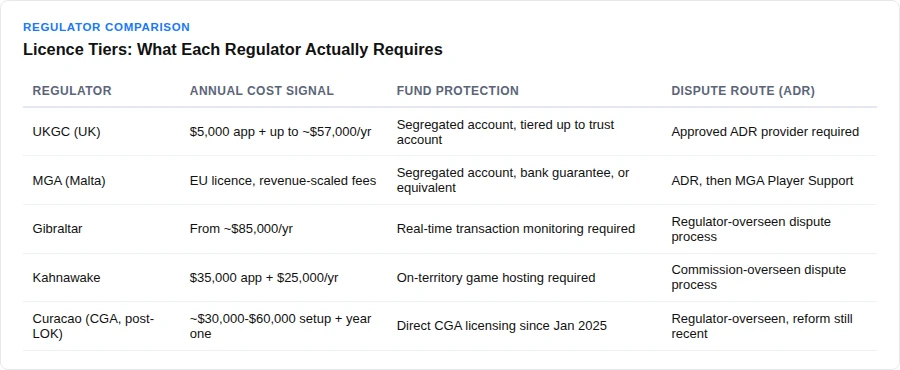
Those numbers are not a ranking of where you should play. They are a rough proxy for how much scrutiny an operator agreed to accept. A jurisdiction charging tens of thousands in annual licensing fees and running compliance audits is signaling a different level of ongoing scrutiny than one that collects a flat fee and does not check back. The cost is the price of the supervision, and the supervision is the thing you are actually relying on.
This is what the number can’t show you. A rating that scores “licensed” gives a Curaçao-licensed operator and a UKGC-licensed operator the same point, even though the two licences impose different obligations, different dispute routes, and different enforcement records. The score is not wrong. It is just silent about the input that matters most.
What changed with Curaçao’s licensing reform?
Curaçao’s licensing reform is a case study in how a jurisdiction’s trust level can shift underneath a static rating, because the mechanics of what changed are concrete and dated.
For decades, Curaçao ran a master-license system. Four private holders bought master licences and resold sub-licenses to operators. The regulator did not license most operators directly. It licensed the middlemen. That structure is why a Curaçao seal was cheap and fast and why it carried less weight. The entity issuing your operator’s permission was a private company.
The National Ordinance on Games of Chance, known by its Dutch abbreviation LOK, took effect on 24 December 2024 and abolished that system entirely. Legacy sub-licenses expired by January 2025. The “orange seal” sub-licenses lost validity permanently on 15 October 2025. From 1 January 2026, licensees must have a physical presence in Curaçao. Direct licensing through the regulator is now mandatory for both B2C casino and sportsbook operators and B2B suppliers.

The regulator itself changed shape. It was renamed from the Gaming Control Board to the Curaçao Gaming Authority, and it moved from the Ministry of Finance to the Ministry of Justice. That relocation is the tell. A gambling supervisor sitting inside a finance ministry is a revenue function. One sitting inside a justice ministry is an enforcement function. The same island, the same licence category, a different institutional purpose.
A rating built in 2023 and not rebuilt since would still score Curaçao the way it scored the master-license era. The licence tier moved. The score did not.
What does enforcement actually look like when a licence is tested?
Enforcement is where a licence stops being paperwork. The UKGC’s public case record gives concrete examples of what happens when compliance fails, and the range of responses is wider than most players assume.
The Commission has ordered one licensee to pay £650,000 over anti-money-laundering and social-responsibility failures, and fined another £10 million for compliance failures. Those are the headline numbers, but the more useful detail is the menu of responses, which runs from financial penalties and mandatory third-party compliance audits to suspension or revocation of the licence in the most serious cases.
That menu is the part a trust score usually flattens. A fine is a cost of doing business. A mandatory audit is an operational intrusion. A suspension takes the operator offline. All three are “enforcement,” and they mean very different things about how seriously the regulator is watching.
Some licence conditions are structural. Since April 2020, UKGC licence condition SR Code 3.5.3 has required every UK-licensed operator, across casino, sportsbook, bingo, poker, and lottery, to integrate with GAMSTOP, the UK’s national self-exclusion scheme. Non-compliance can trigger sanctions, fines, or revocation. That is a licence condition that directly protects a specific kind of vulnerable player, and it exists because the regulator wrote it into the terms.
Affordability checks work the same way. Under the UK Gambling White Paper reforms, UKGC-licensed remote operators must run a light-touch financial-vulnerability check once a customer’s net deposits, meaning deposits minus withdrawals, exceed £150 within a rolling 30-day window. That threshold is a licence requirement. An operator in a jurisdiction without it has no obligation to ask.
How can a player verify a licence claim instead of taking the footer logo on faith?
Look the number up in the regulator’s own public register. It is the single most useful check you can run before depositing.
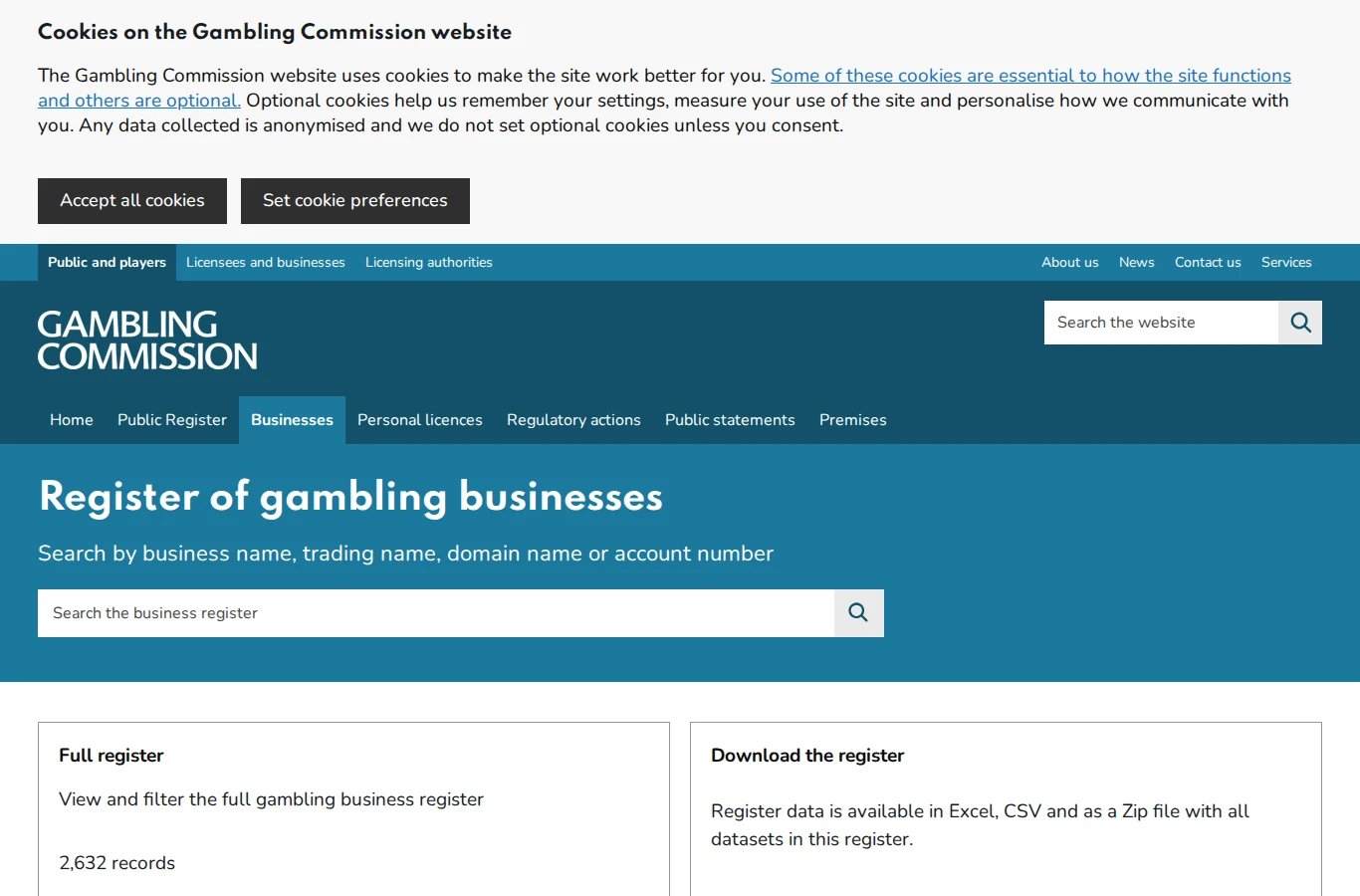
The UKGC’s public register at gamblingcommission.gov.uk shows, for each licence number, the full company name, trading names, registered address, every licence the company holds, the licence conditions attached, and any regulatory action taken. You can search by name or by number, and the number in the register is usually the same one printed in the casino’s footer. If the footer number does not appear in the register, that is your answer.
The MGA’s Licensee Register works the same way. You can search by company name, licence number, URL, or gaming service. The MGA also publishes an enforcement register and, separately, a list of unauthorized URLs that falsely claim an MGA licence. That last list is the one worth knowing about, because a fake licence claim is not always a fake logo. Sometimes it is a real logo attached to a company that never held the licence.
Two things to check once you find the entry. First, does the trading name in the register match the name on the site you are looking at? Second, does the register show any regulatory action? A clean entry is not a guarantee of good behaviour, but a flagged entry is a fact you can act on.
Why should a licence carry more weight in a trust score than it usually does?
Because it is the input that determines whether every other input has a backstop. Bonus terms, withdrawal speed, and support quality are all things an operator controls. A licence is the thing that determines who holds them accountable when those controls fail.
Think about what a rating actually averages. A typical trust score blends licence status, user experience, bonus fairness, payment speed, and support responsiveness into one number. Four of those five inputs are the operator’s own performance. The licence is the only input that describes the referee. When a score compresses the referee into a yes-or-no checkbox, it gives the same weight to “licensed by a supervisor with a public enforcement record” and “licensed by a jurisdiction that did not directly license the operator until recently.”
Squeezing multiple layers into one number always costs something. The question is which details vanish, and whether they mattered. If the regulator’s credibility gets absorbed into a yes-or-no average, the score stops measuring whether your complaint has teeth and starts measuring whether the operator looks attractive. Your remedy becomes invisible in the math.
None of this means a licence makes a casino safe, or that a strict jurisdiction guarantees a good experience. It means the licence is the input that decides whether a bad experience has a remedy. That is a different question from whether the experience is good. The licence deserves its own line in the score.
If you want to see how we handle that weighting, our editorial policy lays out which inputs feed a rating and how they are combined. If you want to set your own limits, our responsible gambling page covers the tools that exist on your side of the screen. And if you want to know who is doing the weighting, that is on the about page.
FAQ
Does a licence guarantee a casino is safe?
No. A licence guarantees three specific things. Player funds are held separately from operational accounts, you have access to a formal dispute route, and the regulator has the power to penalise the operator. It does not guarantee fair bonus terms, fast withdrawals, or good support. Treat the licence as the backstop, not the whole picture.
What is an ADR and how do I use it?
ADR stands for Alternative Dispute Resolution. It is an independent body that hears complaints an operator’s own support has not resolved. Every UKGC licensee must give you access to an approved ADR provider. The MGA requires you to escalate to an ADR first, then to MGA Player Support if the case is still unresolved. Ask support for the ADR provider’s name before you need it.
Is a Curaçao licence worse than a UKGC one?
They impose different obligations, and the gap narrowed after Curaçao’s LOK reform took effect on 24 December 2024. The old master-license system, where four private holders resold sub-licenses, is gone. Direct licensing through the Curaçao Gaming Authority is now mandatory. The two jurisdictions still differ in enforcement record and dispute mechanics, which is why the licence tier belongs in a rating as its own input.
Where do I check a licence number myself?
The UKGC public register at gamblingcommission.gov.uk and the MGA Licensee Register both let you search by licence number or company name. Each entry shows the full company name, trading names, registered address, licence conditions, and any regulatory action. The MGA also publishes a list of unauthorized URLs falsely claiming an MGA licence.
Why does the licence matter more than bonus terms in a rating?
Look at the rating system’s published methodology—it should show the licence as its own input and its relative weight in the final score. Check whether regulator tier matters—a UKGC licence should count differently than a Curaçao one, not as the same checkbox. If the methodology folds the licence into a blended formula without separating the regulator type, the rating is not weighting it more than other inputs; it is averaging it away. Our editorial policy is an example of how to break that down.
18+. Gambling involves risk. This article explains how licensing affects rating methodology and is not advice to gamble. For tools and support, see our responsible gambling page.